The appointment of Steel Traders Midlands Limited as a sales agent for Centravis marks more than the addition of another manufacturer to the company’s portfolio. It brings together Centravis’s specialist capability in seamless stainless-steel tube and pipe with the commercial model Steel Traders has been building around international sourcing, finance, importation and logistics.
For Nick Lally, CEO of Steel Traders, the significance lies less in the announcement itself and more in what the relationship could become. The opportunity, as he sees it, is to combine access to technically demanding products with the ability to manage the commercial and logistical complexity that increasingly surrounds international steel purchasing.
The agreement covers agreed products and customers in the UK and Ireland, with Steel Traders providing a commercial route that can extend from the initial requirement and sourcing conversation through to importation, logistics and final delivery.
Following the announcement, we spoke to Nick about why Centravis was a natural fit for Steel Traders, how he sees the relationship developing and what it could mean for the business and its customers over the coming years.
Nick, now that the announcement is public, what does the Centravis relationship mean to you personally?
It is an important step for us, particularly because Steel Traders is still building its position in the market and establishing the type of business we want to become. To be trusted to represent a manufacturer with Centravis’s technical capability is significant, and naturally we are very pleased to have reached this point.
What interests me most, though, is what happens from here. Announcing a relationship is one thing; building something commercially meaningful from it is another. The real measure will be whether we can use Centravis’s manufacturing expertise alongside the capabilities we have within Steel Traders to help customers solve genuine supply problems and access products in a way that works commercially as well as technically.
That is the opportunity I find exciting, because it gives us something we can develop rather than simply something we can announce.
What made Centravis such a good fit for Steel Traders?
There is a natural overlap between their strengths and the direction we have been taking Steel Traders.
Centravis has a significant depth of manufacturing expertise in seamless stainless-steel tube and pipe, including products used in some highly demanding industrial environments. For us, that creates access to a level of technical capability that complements the commercial side of what we already do.
Our role is not to try to replicate the knowledge of the manufacturer. It is to understand what the customer needs, bring the right people into that conversation and then make the transaction work from a commercial and logistical perspective.
In practice, that can involve much more than simply obtaining a price. We may be looking at how an order is financed, how it is shipped, what the import implications are, how customs and duties are managed, where material might need to be stored and ultimately how it reaches the customer.
When you combine strong manufacturing expertise at one end of the process with a team capable of managing the commercial route around it, there is a very clear fit.
Is that becoming more important as international steel buying becomes more complicated?
I think it is. Steel procurement has always involved more than the headline price, but there are now more factors that buyers have to consider and those factors increasingly interact with one another.
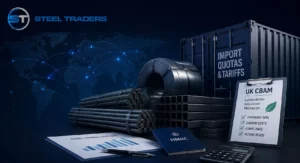
You obviously start with the fundamentals: the specification, availability, price and lead time. Once you are sourcing internationally, however, you also need to consider freight, duties, quota exposure, tariffs, customs, financing, storage and delivery. Alongside that, businesses are having to pay greater attention to changing carbon-related requirements and what those could mean for imported material.
What matters to the customer in the end is not simply the number on the mill quotation. They need to understand what the material will cost once it has travelled through the entire supply chain and arrived where it is required, with the correct documentation and within the timeframe they are working to.
That broader picture is where we spend a lot of our time. We are looking at the transaction as a whole rather than treating the product and everything surrounding it as separate issues.
So where does Steel Traders add value in a Centravis transaction?
I think our value comes from being able to connect those different elements and give the customer one commercial point of contact.
Some enquiries will arrive with a very clear specification, drawing, grade or standard, while others will be less defined and may need further discussion before the right supply route becomes clear. In either case, we can take that requirement into the conversation with Centravis and then manage the commercial process that follows.
That might include sourcing, finance, shipping, importation, customs administration, haulage, storage, logistics and payments, depending on what the customer requires.
For many businesses, particularly those that do not regularly manage complex international steel purchases, having somebody coordinate those areas can make a significant difference. Instead of having to deal separately with a manufacturer, freight provider, customs agent, finance provider and logistics company, they have a team that understands how those parts of the transaction fit together and can take responsibility for managing them.
That has always been central to the Steel Traders model, and the Centravis relationship gives us the opportunity to apply it to a much broader range of specialist tubular products.
The Centravis portfolio covers some highly specialist applications. Does that change the type of work Steel Traders can pursue?
It certainly broadens the conversations we can have.
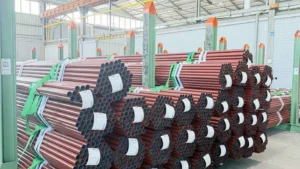
Centravis manufactures seamless stainless-steel tube and pipe for a wide range of applications, including chemical and petrochemical processing, oil and gas, power generation, heat exchange, instrumentation and mechanical engineering. The portfolio also extends into specialist stainless grades, duplex and super duplex materials, nickel alloys and products designed for more demanding applications.
That gives us considerable scope, but I do not think the right approach is simply to work through a product list and decide that we are going to target every possible market.
The more interesting part is understanding where those manufacturing capabilities meet genuine needs in the UK and Ireland. That comes from speaking to customers, listening to the difficulties they are encountering and identifying where Centravis can provide an answer that may not currently be obvious to them.
Some opportunities will be apparent relatively quickly, while others will emerge as our knowledge of the range deepens and the relationship becomes more established. I would expect that process to continue over a long period rather than everything being defined at the beginning.
Is Steel Traders deliberately moving towards more specialist and technically demanding work?
I would describe it slightly differently. We are deliberately moving towards work where we believe we can add more value.
There will always be relatively straightforward steel transactions and those remain an important part of the market, but we do not want Steel Traders to be defined by how many quotations we can send or how many products we can put in a catalogue.
The more interesting opportunities tend to be the ones where a customer has a problem that requires some thought. It may be an unusual specification, difficulty securing supply, a challenging logistics route or a transaction that needs to be structured differently from a financial perspective.
Those are situations where our experience and relationships can genuinely contribute something.
If we become known as a business that customers call when the requirement is not completely straightforward, I think that is a very strong position to occupy. The Centravis relationship strengthens our ability to do that when the requirement involves specialist stainless tubular products.
What does success look like for you? Is it simply about selling more tonnes?
The relationship obviously needs to make commercial sense for both businesses, and ultimately we are all in business to generate a return. I would not pretend otherwise.
At the same time, I think measuring the relationship purely in tonnes would overlook the wider opportunity.
I would like Steel Traders to build a reputation for being able to help customers with more specialist tubular requirements and, over time, for the market to recognise that we have both access to Centravis’s manufacturing capability and the commercial expertise required to build a workable supply solution around it.
If a customer has a difficult requirement and their instinct is to speak to us because they believe we may know how to approach it, that is valuable. It means we have earned a degree of trust and established a position that goes beyond simply competing on price.
The commercial results should follow from doing that consistently.
How important is the relationship between Steel Traders and the mill itself?
It is extremely important because the strongest supplier relationships are rarely purely transactional.
We need to build a detailed understanding of Centravis: where they are particularly strong, which products and markets play to those strengths and how best to work with their technical and commercial teams. That knowledge allows us to represent them properly rather than simply presenting ourselves as another route through which a customer can request a quotation.
There is also information that can travel in the other direction. Through our conversations with customers in the UK and Ireland, we are able to see what specifications are appearing, where buyers are experiencing supply difficulties, which sectors are active and where there may be gaps between what the market needs and what is currently available.
Over time, that exchange of knowledge should make the relationship stronger on both sides. We become better informed about what Centravis can offer, while they gain a clearer picture of what is happening in the markets and customer base we are working with.
That kind of relationship takes time to develop, but it is also where much of the long-term value lies.
There is a lot of discussion around changing global supply chains at the moment. Do you think the role of the steel trader is changing as well?
I think good traders have probably always done considerably more than the traditional description of simply buying material at one price and selling it at another would suggest. What has changed is that the wider role has become increasingly important because the supply chain itself has become more complex.
Customers have to think about where material is coming from, the reliability of that supply, trade measures, logistics, financing, documentation and regulation, as well as the technical suitability of the product itself. Those considerations cannot always be separated neatly because a decision made in one area can affect the economics or viability of the entire transaction.
That creates a role for a trading business that understands how the different elements fit together and has the relationships required to manage them.
We are not trying to remove complexity by pretending it does not exist. International steel trading is complex and, in many areas, is becoming more so. What we can do is understand that complexity, manage it properly and prevent the customer from having to deal with every element of the process independently.
For me, that is an increasingly important part of what a modern steel trading business should provide.
Finally, where would you like the Centravis relationship to be a few years from now?
I would like it to be sufficiently established that the relationship no longer needs much explanation.
Customers would understand who Centravis is, what their manufacturing strengths are and what Steel Traders brings to the process. We would have developed a much clearer understanding of where the opportunities lie, and both companies would know how to work together effectively when a requirement comes through.
More importantly, I would like us to be able to look back at individual projects where the relationship genuinely made a difference for the customer. That might mean finding the right technical solution for a difficult application, creating a more effective commercial route to supply or simply taking a complicated purchase and making it considerably easier to manage.
If we can build that kind of track record, then we will have created something worthwhile.
The announcement gives us the platform. What matters now is how we develop the relationship from here and what we are able to deliver for customers as a result.