Over the last decade, global sourcing has become easier than ever. Buyers can now contact mills directly across Europe, Asia and the Middle East with a few emails or calls. On paper, direct purchasing may appear to remove an extra layer from the supply chain.
In reality, the steel market rarely works that simply.
For many stockholders, distributors, engineering companies and end users, experienced steel trading companies remain a critical part of the global supply chain, not because they add cost, but because they add flexibility, security, market access and commercial support.
The Reality of Mill Purchasing
Steel mills are designed to manufacture steel efficiently at volume. Their focus is production, capacity utilisation and large-scale order flow.
Most mills prefer:
- Large tonnage orders
- Standard rolling programmes
- Long lead-time scheduling
- Limited product variation
- Predictable repeat business
That model works well for very large consumers with stable demand. However, many buyers operate in markets where requirements constantly change.
Projects move. Specifications change. Freight costs fluctuate. Quotas close unexpectedly. Tariff rules change. Delivery dates move forward. Customers suddenly need mixed sizes, urgent tonnage or alternative origins.
This is where steel traders become valuable.
Navigating A Disrupted Global Market
The global steel market has become increasingly volatile over recent years. International trade is now heavily influenced not only by supply and demand, but also by politics, regulation and geopolitical conflict.
The industry has faced continual disruption from:
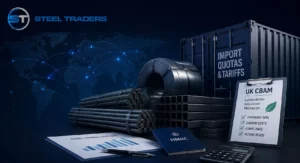
- Safeguard quotas and import tariffs
- Anti-dumping measures
- Sanctions and trade restrictions
- Red Sea shipping disruption
- Rising fuel and freight costs
- Port congestion and container shortages
- Ongoing conflict and instability in the Middle East
These issues can change the economics of a shipment almost overnight.
A cargo that appears competitive at the point of order can quickly become exposed to:
- Additional duty costs
- Closed quota categories
- Shipping delays
- Diversion around restricted sea routes
- Increased insurance premiums
- Sudden freight escalation
Companies relying solely on direct mill purchasing can find themselves highly exposed when markets move unexpectedly.
Experienced steel traders constantly monitor these developments and react quickly to protect supply chains wherever possible. Alternative origins, revised shipping routes, replacement mills and adjusted delivery programmes can often be arranged before disruption reaches the end customer.
Flexibility Across Multiple Supply Sources
One of the biggest advantages of using a steel trader is access to a broad international supply network rather than dependence on one producer.
A trader can source:
- Tube and pipe from one mill
- Hollow sections from another
- Stainless products elsewhere
- Specialist engineering grades from different regions
If one mill experiences delays, allocation problems or export restrictions, alternative sources can often be secured quickly.
That flexibility becomes increasingly important during periods of global instability.
Smaller Quantities Still Matter
Not every buyer requires full mill quantities.
Many projects require mixed dimensions, smaller lots or split deliveries. Mills are rarely structured to efficiently handle this type of requirement.
Steel traders bridge that gap by:
- Breaking bulk cargoes
- Combining products
- Consolidating shipments
- Offering flexible quantities
- Supporting urgent requirements
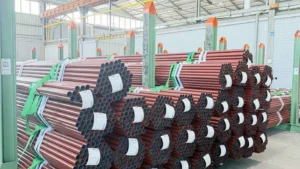
This is particularly important within the steel tube and pipe sector where projects regularly require numerous sizes and specifications within one order.
Logistics Has Become Just As Important As The Steel Itself
International steel procurement is no longer simply about buying material.
The modern supply chain involves:
- Freight management
- Customs clearance
- Port handling
- Marine insurance
- Transport coordination
- Duty and tariff management
- Certification control
A good trader effectively becomes an extension of a customer’s procurement and logistics department.
For many businesses, this reduces both operational pressure and commercial risk.
Market Knowledge Matters
Steel remains one of the most globally sensitive industrial markets in the world.
Pricing can change rapidly based on:
- Scrap movements
- Energy prices
- Chinese exports
- Currency shifts
- Freight rates
- Political developments
- Mill production cuts
- Government trade measures
Experienced traders spend every day monitoring these factors and maintaining close relationships with mills, shipping companies, insurers and financial institutions.
That market visibility often allows customers to make faster and better-informed purchasing decisions while avoiding unnecessary exposure to volatile market conditions.
Finance And Commercial Support
Direct mill buying can also place significant pressure on working capital.
Many mills require:
- Advance payments
- Letters of credit
- Large-volume commitments
- Tight payment terms
Trading companies can frequently offer more flexible commercial structures, helping customers manage cash flow more effectively while still securing competitive international supply.
The Modern Steel Trader
The idea of the steel trader as simply a “middleman” is outdated.
Today’s trading companies operate as:
- Global sourcing specialists
- Supply chain managers
- Risk management partners
- Logistics coordinators
- Market intelligence providers
- Commercial facilitators
For many customers, the value lies not only in the steel itself, but in the ability to secure reliable supply with reduced complexity and lower overall risk.
Final Thoughts
Direct mill purchasing absolutely has its place within the steel industry, particularly for major volume buyers with long-term predictable demand.
However, for many businesses, working with an experienced international steel trader provides a level of flexibility, responsiveness and market access that direct mill relationships alone cannot always deliver. In a fast-moving and increasingly unpredictable global market, having a knowledgeable trading partner can make a major commercial difference.